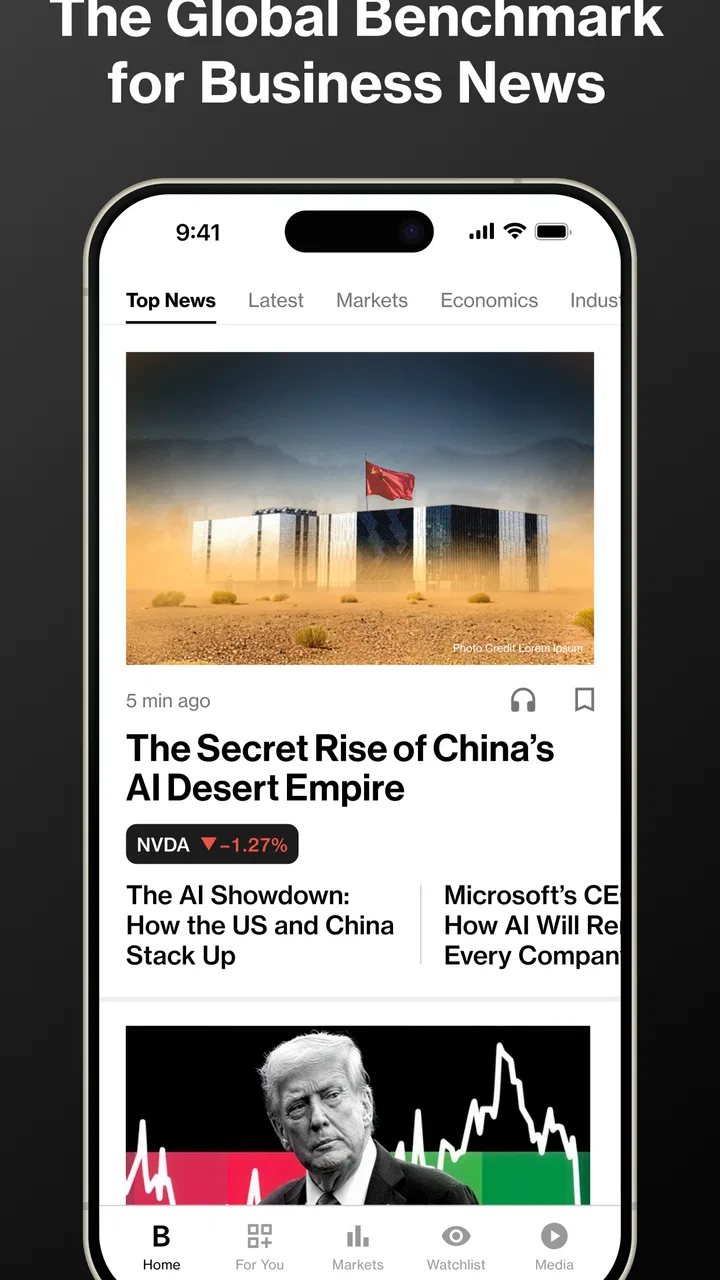
Bloomberg: Finance Market News
- 4.0
- Rating
- 10.00M
- Installs
- Free
- Price

 Analysis by App-foxy
I approached Bloomberg: Finance Market News as a practical news app rather than as a replacement for a full trading terminal. That distinction matters. Its focus is business, economics, markets, and investment-related information, so it makes the most sense when I want a quick view of what may be moving companies, industries, or broader financial sentiment. I would recommend it to someone who follows the markets regularly and wants a familiar financial-news source on a phone, but I would not treat it as the only tool for making an investment decision.
The app is free to install, is published by Bloomberg LP CM, and sits in the News & Magazines category. It has reached over ten million installs, with an average rating of 3.9 from around eighty thousand ratings and roughly six thousand reviews. Those figures suggest a widely used product with a mixed but substantial audience. My own impression is that the experience is strongest when I use it for context: understanding why a market story matters, checking the direction of a developing business event, or catching up on financial headlines before deciding whether I need deeper research elsewhere.
How Bloomberg earns trust, and where I still stay careful
I judge trust in a financial-news app not just by the name on the screen, but by how carefully I separate reporting from interpretation and keep my own choices in view. I use Bloomberg to identify questions worth checking, then look for primary material before relying on details that could affect a decision. That distinction is especially useful when a story feels urgent, and it leads naturally to the practical habits that make the app easier to use without letting headlines dictate my day.
You May Also Like

 AccuWeather: Weather Radar
AccuWeather Review: A Quick, Clear Forecast for Everyday Decisions
For everyday plans, the best forecast is the one you can understand quickly. AccuWeather makes rain timing, radar, and local conditions easy to act on, with a few trade-offs.

 Hill Climb Racing
Why Hill Climb Racing Still Turns Crashes Into One More Run
A tiny car, a bumpy hill and one more upgrade: Hill Climb Racing keeps resurfacing because its simple chaos makes every near-miss feel personal.

 AliExpress - Shopping App
AliExpress Makes Global Shopping Feel Personal, but Shoppers Bear the Risk
AliExpress turns a global marketplace into a pocket-sized discovery engine. Its reach is useful, its shopping loop compelling, and its trade-offs easy to miss.

 Lords Mobile: Kingdom Wars
Lords Mobile Is a Kingdom-Building Routine, Not a Quick Match
A case-by-case verdict on the building, battles, device demands, and social commitments that make Lords Mobile rewarding for some players and exhausting for others.

 PDF Scanner app - TapScanner
TapScanner Makes Paperwork Easier to Capture, Check, and Share
TapScanner makes scanning with a phone feel less like a rescue operation and more like a dependable step in getting work done. Its capture tools are useful, though not flawless.

 Block Blast!
 Shows How Much a Puzzle Game Can Leave Out
A quiet grid game shows why puzzle players increasingly value instant clarity, repeatable skill and low-pressure play—and where the genre still needs to catch up.
More From Our News Desk
View All News


A recognizable source for financial context
The main reason I would open this app instead of a general news reader is its editorial focus. A broad news application may tell me that a company is facing trouble, but Bloomberg’s financial coverage is more likely to place that event alongside markets, business conditions, economic policy, or investment concerns. That framing is useful because a headline rarely explains its full effect on an industry or portfolio.
I also like the separation between simply watching a price move and understanding the story behind it. A market can react to an earnings announcement, a central-bank decision, a regulatory development, or a change in investor expectations. A finance-focused news app gives me a better chance of seeing those connections than a standard headline feed. Still, I remind myself that a well-written article is analysis and reporting, not personal financial advice.
The app is suitable for Everyone 10+, which fits its role as a general news product with financial subject matter. I would be comfortable suggesting it to an adult who is learning how markets work, although a beginner may need to look up unfamiliar terms. The writing can assume that the reader already understands ideas such as yields, indexes, guidance, or sector rotation. That is not a flaw in the journalism, but it does affect how approachable the app feels.
What the rating tells me about the experience
The 3.9 average indicates that the app is useful to many people but does not satisfy everyone equally. I think that is believable for a service combining fast news, market information, and optional paid content. Some readers will value the depth and professional tone, while others may find the interface busy, encounter limits around premium material, or simply prefer a lighter news experience.
I would not use the rating alone to judge the quality of the reporting. Instead, I would ask whether the app fits my reading habits. If I want business news with financial relevance, the editorial direction is a good match. If I only want a few general headlines each morning, a conventional news app may feel faster and less demanding.
Controls that deserve a deliberate look
One point I take seriously with any news app is the difference between reading freely and entering a more personalized experience. Before signing in, I would inspect what the app lets me browse without an account and what becomes available only after creating one. I would also look at the account area for options related to subscriptions, saved preferences, notifications, and any connected services.
I am deliberately cautious about permissions and data practices. The app’s presence on a phone does not automatically tell me what access it requests or how every piece of information is handled. I would read the permission prompts instead of approving them reflexively, and I would revisit the operating system’s permission manager if a request did not seem relevant to the way I planned to use the app.
My trust rule is simple: I want clear choices before I share more than is necessary for reading news. If I only need headlines and articles, I would avoid granting unrelated access. If a feature requires an account or a paid plan, I would expect that requirement to be visible before I commit, not discovered after I have built the app into my daily routine.
Free access and the paid boundary
Bloomberg: Finance Market News is free to download, but it includes in-app purchases ranging from $29.99 to $399.99 per item. That is the most important practical detail for anyone considering it. The free entry point makes it easy to test the app, yet the possible cost of premium access is significant enough that I would never subscribe casually.
Before paying, I would check exactly what the selected purchase unlocks, whether it renews, and how cancellation works through the relevant app-store account. I would also compare the price with how often I expect to use the service. A person who reads financial news several times a day may find paid access easier to justify than someone who opens the app only during major economic events.
This pricing structure changes my recommendation. I can suggest trying the free experience, but I would not describe the app as simply a free financial-news solution. The correct expectation is a free download with optional purchases that may become relevant if I want a more complete or sustained experience.
When personal data becomes more sensitive
Financial news is not the same as a banking app, but it can still become sensitive when I connect reading habits with investment interests. Articles I follow, topics I search for, alerts I enable, and companies I monitor may reveal what matters to me financially. That does not mean the app is unsafe; it means I should pay attention to the choices I make around personalization and accounts.
I am especially careful when an app offers portfolio-related tools or market tracking. A portfolio is more personal than a general news feed because it can reflect holdings, watchlists, or investment plans. I would enter only the information needed for the feature I actually intend to use, and I would avoid treating a convenient tracking tool as a secure substitute for my broker or financial institution.
The same caution applies to notifications. Breaking market alerts can be valuable, but too many can turn a useful news source into a constant source of distraction. I would begin with only the subjects that affect my work or investments, then adjust after a few days. This is a small setting, but it has a large effect on whether the app supports thoughtful reading or encourages impulsive checking.
A realistic morning workflow
My preferred use would be a short morning routine. I would open the app before work, scan the leading business and economic stories, and choose only the articles connected to sectors or companies I follow. I would then write down the questions raised by those stories rather than immediately acting on them: Is this a temporary event? Does it affect an entire industry? Is the market response already reflected in the price?
That workflow turns the app into a context filter instead of a trading trigger. I might use a separate market-data service for precise prices, a company filing for primary information, and my broker for any transaction. Bloomberg’s role would be to help me decide what deserves further attention. This division of labor is safer and more realistic than expecting one mobile news app to provide every answer.
How it compares with ordinary news apps
Compared with a general news reader, Bloomberg offers a narrower but more useful lens for readers who care about finance. The advantage is concentration: business and market stories are not competing with an unrelated stream of entertainment, local updates, and lifestyle content. The trade-off is that the app may feel too specialized if my interests are broad.
Compared with a broker’s app, it serves a different purpose. A broker is built around holdings, orders, account balances, and execution. Bloomberg is better suited to reporting and interpretation. I would not choose it for placing trades, and I would not expect a brokerage application to provide the same editorial depth. Using both can make sense, provided I keep news consumption separate from the moment I decide whether to buy or sell.
Compared with a dedicated market terminal, this app is naturally more convenient for casual mobile reading but less appropriate for professional, intensive analysis. Someone who needs highly specialized tools, extensive historical work, or a workstation-style environment should look elsewhere. For a commuter, student, manager, or individual investor who needs a compact news habit, the phone format is more practical.
Small habits that improve the experience
First, I would avoid reading only the headline. Financial headlines are designed to summarize quickly, while the important qualification may appear later in the article. Reading the opening sections and identifying what is known, what is expected, and what remains uncertain gives me a more balanced view.
Second, I would separate a company story from a recommendation. An article can explain an event without telling me what action to take. That distinction prevents me from turning information into an automatic trade, especially when markets are moving quickly.
Third, I would review notification and account settings after the initial setup instead of leaving every default untouched. This helps me control interruptions and makes it easier to notice whether I am using a free reading experience or moving toward a paid feature.
Fourth, I would periodically compare the app’s coverage with primary sources. For company matters, that may mean official announcements or filings; for economic matters, it may mean the originating institution’s release. Bloomberg can help me discover and understand an event, while primary material helps me verify the details that matter most to my decision.
Who should use it, and who should skip it
I think the app is a good fit for readers who want business and market news in one place, professionals who need a quick economic briefing, and investors who already understand that news is only one part of research. It is also useful for students who want to become more familiar with the language of finance, as long as they are willing to investigate unfamiliar concepts rather than assuming every headline is self-explanatory.
I would be more hesitant to recommend it to someone who wants only local or general-interest news, dislikes financial terminology, or expects a completely free experience with no meaningful premium boundary. I would also steer away anyone looking for a single tool to manage investments, provide personalized financial advice, and execute transactions. That is not the role I would assign to this app.
People who are sensitive to notifications should configure them immediately. Readers who are uncomfortable creating accounts or sharing reading preferences should begin with the parts available without signing in and make each decision carefully. In every case, the right approach is to use the app for information while keeping personal financial records and trading activity in services designed specifically for those purposes.
My cautious verdict
After using Bloomberg: Finance Market News as a financial-news companion, I see a focused app with a clear strength: it helps connect business events with the markets and the wider economy. Its large audience and established developer add context, but they do not remove the need to inspect permissions, account controls, notification choices, and purchase terms for myself.
I would start with the free version, limit notifications to topics I genuinely follow, and avoid entering portfolio details unless a specific feature makes that worthwhile. I would also treat every article as a starting point for research rather than a direct instruction. That approach preserves the app’s value while reducing the risk of rushed decisions or unwanted account commitments.
My final recommendation is conditional but positive: choose it if you want serious business and market coverage on a phone and are prepared to manage the paid boundary thoughtfully. Skip it if you want a simple general-news feed or a complete investing platform. For the right reader, Bloomberg: Finance Market News is most useful not as a trading button, but as a disciplined first stop for understanding what is happening and deciding what deserves closer attention.
FAQs for Bloomberg: Finance Market News
01What features does Bloomberg: Finance Market News offer?
Bloomberg: Finance Market News provides a comprehensive suite of features including real-time market data, personalized news alerts, and expert analysis. Users can access detailed financial reports, stock market updates, and economic insights. The app also offers customization options for tracking investments and portfolios. It's a powerful tool for both amateur and professional investors.
02Is Bloomberg: Finance Market News free to use?
Bloomberg: Finance Market News offers a free version with limited access to essential features. However, to unlock the full potential of the app, including in-depth analysis and exclusive content, users can opt for a subscription. The subscription provides a more robust experience, catering to serious investors and finance enthusiasts.
03How user-friendly is the Bloomberg app for beginners?
The Bloomberg app is designed with a user-friendly interface, making it accessible to both beginners and seasoned investors. It includes tutorials and guides to help new users navigate the app efficiently. With intuitive navigation and customizable dashboards, it caters to users who may not have extensive financial knowledge but are eager to learn.
04Can I customize notifications and alerts in Bloomberg: Finance Market News?
Yes, the app allows users to customize notifications and alerts to match their specific interests and investment strategies. You can set alerts for breaking news, stock price changes, and economic developments. This feature ensures you stay informed about market movements and updates relevant to your investments, keeping you one step ahead.
05Is Bloomberg: Finance Market News available on both Android and iOS?
Bloomberg: Finance Market News is available on both Android and iOS platforms, ensuring a seamless experience across different devices. The app is optimized for smartphones and tablets, providing flexibility and convenience for users to stay updated on financial news and market trends anytime, anywhere.
Pros
- Comprehensive financial news coverage.
- User-friendly interface for easy navigation.
- Real-time market data updates.
- Customizable alerts for stock movements.
- In-depth analysis and expert insights.
Cons
- Premium features require subscription.
- Occasional slow loading times.
- Limited offline functionality.
- High data usage for continuous updates.
- Complex interface for beginners.

Bloomberg: Finance Market News
Gallery